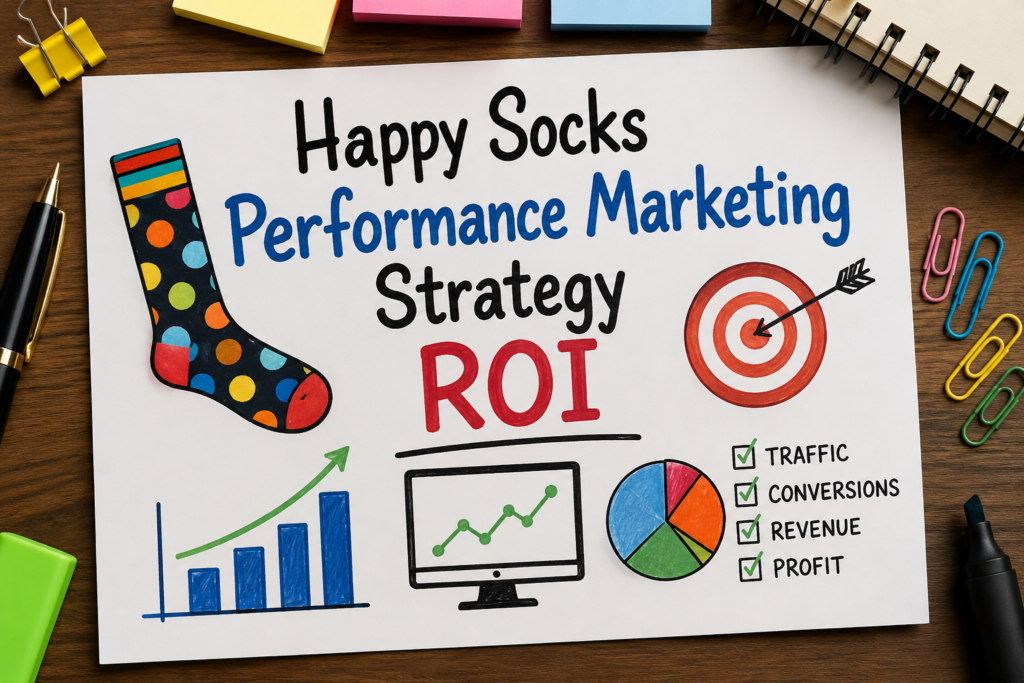

Explore 7 key Happy Socks Performance Marketing Strategy ROI insights, including campaign growth, performance tactics, and measurable marketing results.
Introduction
Colorful products alone do not create a global brand. Behind every successful ecommerce company is a marketing engine that attracts customers, converts traffic into sales, and generates measurable returns. One of the most interesting examples of a successful Happy Socks performance marketing strategy ROI is the growth story behind Happy Socks.
Known for its vibrant designs and distinctive branding, Happy Socks transformed a simple everyday product into a worldwide fashion statement. However, the company’s success is not only about creativity. A major factor behind its expansion is a well-executed Happy Socks performance marketing strategy ROI approach focused on measurable results, customer acquisition, and long-term profitability.
Understanding the Happy Socks performance marketing strategy ROI provides valuable insights for ecommerce brands, digital marketers, and business owners looking to improve customer acquisition, increase conversions, and maximize marketing returns.
In this guide, we will explore how the Happy Socks performance marketing strategy ROI contributes to the brand’s growth, the tactics that improve marketing efficiency, and practical lessons businesses can apply to achieve stronger results from their own digital campaign
What Is Performance Marketing?
erformance marketing is a digital marketing approach where advertisers pay based on specific results. These results may include clicks, leads, sales, app installs, or other measurable actions.
Unlike traditional advertising, performance marketing focuses heavily on data, analytics, and optimization. Every campaign is evaluated based on its effectiveness and contribution to revenue.
Common performance marketing channels include:
- Paid search advertising
- Social media advertising
- Affiliate marketing
- Email marketing
- Influencer partnerships
- Display advertising
- Retargeting campaigns
For a direct-to-consumer brand like Happy Socks, performance marketing plays a crucial role in scaling customer acquisition while maintaining profitability.
Understanding Happy Socks as a Brand
The company quickly gained attention by transforming ordinary socks into stylish accessories. Through unique designs, premium quality, and memorable branding, Happy Socks expanded into multiple international markets. This growth highlights the effectiveness of the Happy Socks performance marketing strategy ROI, which combines strong branding with measurable digital marketing efforts.
Today, the brand sells products through ecommerce channels, retail partnerships, and physical stores, serving customers across numerous countries. A significant factor behind this success is the Happy Socks performance marketing strategy ROI, which focuses on attracting and retaining customers efficiently across multiple channels.
While the products are visually appealing, the real business challenge lies in acquiring customers efficiently and generating consistent revenue growth. The strong Happy Socks performance marketing strategy ROI demonstrates how data-driven marketing can support sustainable business expansion.
This is where performance marketing becomes essential. By leveraging targeted campaigns, analytics, and continuous optimization, the Happy Socks performance marketing strategy ROI helps the company maximize revenue while maintaining profitable customer acquisition costs.
Why ROI Matters in Performance Marketing
Return on investment measures how effectively marketing spending generates revenue.
The basic formula is:
ROI = (Revenue Generated – Marketing Cost) ÷ Marketing Cost × 100
For ecommerce businesses, a positive ROI indicates that campaigns generate more revenue than they cost.
Happy Socks focuses on maximizing ROI by:
- Lowering customer acquisition costs
- Increasing conversion rates
- Improving customer lifetime value
- Enhancing customer retention
- Optimizing advertising budgets
Every marketing decision ultimately connects back to profitability.
The Core Elements of the Happy Socks Performance Marketing Strategy ROI
Data-Driven Decision Making
One of the strongest characteristics of successful performance marketing is reliance on data rather than assumptions. This principle is at the core of the Happy Socks performance marketing strategy ROI, where every decision is guided by measurable insights instead of guesswork.
Happy Socks likely tracks key metrics such as website traffic, conversion rates, customer acquisition costs, average order value, return on ad spend, and repeat purchase rates. These metrics directly influence the Happy Socks performance marketing strategy ROI, helping the brand understand what drives profitability and where improvements are needed.
By continuously analyzing customer behavior, marketers can identify opportunities for improvement. In the context of the Happy Socks performance marketing strategy ROI, this means refining campaigns based on real user data to maximize efficiency and revenue impact.
For example, if a campaign attracts high traffic but low conversions, landing pages or product pages may need optimization. This type of adjustment strengthens the Happy Socks performance marketing strategy ROI by increasing conversion efficiency without raising advertising costs.
This data-first approach improves efficiency and increases ROI over time, making the Happy Socks performance marketing strategy ROI a key driver of sustainable ecommerce growth.
Strong Social Media Advertising
Social media platforms provide significant opportunities for visually driven brands.
Happy Socks benefits from colorful products that naturally attract attention on platforms such as Instagram, Facebook, Pinterest, and TikTok.
Effective social media advertising helps the brand:
- Reach new audiences
- Showcase product collections
- Promote seasonal campaigns
- Retarget previous visitors
- Increase brand awareness
Creative visuals combined with audience targeting create a powerful formula for driving sales.
Since every campaign can be measured precisely, marketers can quickly identify high-performing ads and scale them.
Audience Segmentation
Not all customers have identical interests.
A student buying novelty socks differs from a professional purchasing gift sets or premium collections.
Happy Socks improves ROI by segmenting audiences based on:
- Demographics
- Purchase history
- Geographic location
- Interests
- Shopping behavior
Personalized messaging generally generates higher engagement and conversion rates compared to generic advertising.
The more relevant the message, the better the marketing performance.
Search Engine Marketing and Organic Visibility
Paid Search Advertising
Search advertising captures customers who are already looking for products.
For example, users searching for:
- Colorful socks
- Funny socks
- Designer socks
- Gift socks
- Premium sock brands
represent high-intent buyers.
Happy Socks can target these searches through paid campaigns, directing users to optimized landing pages.
Since search traffic often contains strong purchase intent, conversion rates are typically higher than many other channels.
This contributes positively to overall ROI.
SEO as a Long-Term Investment
While paid advertising delivers immediate traffic, SEO generates long-term value.
Happy Socks benefits from creating content around:
- Fashion trends
- Styling guides
- Gift ideas
- Seasonal collections
- Product education
Organic traffic reduces dependence on paid advertising and lowers acquisition costs over time.
A balanced strategy that combines SEO and paid marketing often produces stronger ROI than relying on one channel alone.
Retargeting: Recovering Lost Sales
Most ecommerce visitors do not purchase during their first visit.
Some customers browse products, compare prices, or simply get distracted.
Retargeting helps reconnect with these potential buyers.
Happy Socks can use retargeting ads to remind visitors about:
- Viewed products
- Abandoned carts
- Limited-time offers
- New arrivals
Because these users have already shown interest, conversion rates are often significantly higher than cold traffic campaigns.
This makes retargeting one of the highest-ROI performance marketing tactics available.
Email Marketing and Customer Retention
Customer acquisition is expensive.
Retaining existing customers is usually more cost-effective.
Happy Socks likely leverages email marketing to:
- Announce new collections
- Share exclusive promotions
- Encourage repeat purchases
- Promote seasonal gifts
- Re-engage inactive customers
Email campaigns often generate excellent ROI because the audience has already expressed interest in the brand.
A well-designed email sequence can increase customer lifetime value substantially.
Influencer Marketing and Measurable Results
Influencer marketing has evolved beyond simple brand awareness campaigns.
Modern performance marketing focuses on measurable outcomes.
Happy Socks works naturally within influencer ecosystems because its products are highly visual and easy to showcase.
Effective influencer partnerships may include:
- Product reviews
- Styling videos
- Social media posts
- Seasonal promotions
- Affiliate collaborations
When brands track clicks, conversions, and sales generated by influencers, ROI becomes easier to measure.
This transforms influencer marketing from a branding activity into a performance-driven channel.
Conversion Rate Optimization
Driving traffic alone is not enough.
The website must convert visitors into customers.
Happy Socks likely invests in conversion rate optimization through:
Product Page Improvements
High-quality images, detailed descriptions, and customer reviews improve buyer confidence.
A stronger product page can significantly increase conversions without increasing advertising costs.
Mobile Optimization
A large percentage of ecommerce traffic comes from mobile devices.
Fast loading times and seamless mobile experiences reduce friction during the purchasing process.
Simplified Checkout
Complex checkout processes often lead to cart abandonment.
Streamlined checkout experiences improve conversion rates and increase revenue.
Even small improvements can generate substantial ROI gains.
Seasonal Campaigns and Promotional Strategy
Seasonal shopping periods create major opportunities for ecommerce brands.
Happy Socks can capitalize on occasions such as:
- Christmas
- Valentine’s Day
- Father’s Day
- Mother’s Day
- Back-to-school season
- Holiday gift shopping
Seasonal campaigns often generate increased purchase intent.
When executed effectively, they produce strong returns on marketing investments.
The combination of creative promotions and performance marketing allows the brand to maximize revenue during peak periods.
Customer Lifetime Value and ROI
Many businesses focus exclusively on first-time purchases.
However, customer lifetime value often determines long-term profitability.
If a customer makes multiple purchases over several years, acquiring that customer becomes more valuable.
Happy Socks can increase lifetime value through:
- Loyalty programs
- Personalized recommendations
- Subscription models
- Product bundles
- Exclusive member benefits
Higher lifetime value allows brands to spend more aggressively on customer acquisition while maintaining positive ROI.
This creates a sustainable growth model.
Real-World Lessons Businesses Can Learn
Focus on Measurable Outcomes
Every marketing activity should connect to specific business objectives.
Tracking conversions, revenue, and acquisition costs helps identify what truly works.
Invest in Creative Assets
Happy Socks demonstrates that strong visuals can significantly improve campaign performance.
Creative quality often influences click-through rates and engagement levels.
Balance Acquisition and Retention
Sustainable growth requires both new customers and repeat buyers.
Brands that prioritize retention often achieve better long-term ROI.
Test Continuously
Performance marketing is an ongoing optimization process.
Testing different audiences, ad creatives, landing pages, and offers reveals opportunities for improvement.
Build a Strong Brand
Performance marketing works best when supported by recognizable branding.
Happy Socks combines memorable products with data-driven advertising, creating a powerful competitive advantage.
Challenges in Measuring Performance Marketing ROI
Despite sophisticated analytics, measuring ROI is not always straightforward.
Several factors complicate attribution:
- Multiple customer touchpoints
- Cross-device behavior
- Offline purchases
- Brand awareness effects
- Long buying cycles
Successful companies use advanced analytics tools and attribution models to gain a clearer understanding of marketing performance.
The goal is continuous improvement rather than perfect measurement.
The Future of Happy Socks Performance Marketing Strategy ROI
Digital marketing continues evolving rapidly.
Emerging trends likely influencing future ROI include:
- Artificial intelligence-driven targeting
- Predictive analytics
- First-party data strategies
- Personalized shopping experiences
- Advanced customer segmentation
- Marketing automation
Brands that adapt quickly to these changes will maintain stronger competitive positions.
Happy Socks appears well-positioned to leverage these innovations while continuing to optimize marketing performance.
Conclusion
The Happy Socks performance marketing strategy ROI demonstrates how creativity and analytics can work together to drive business growth. While the brand is famous for colorful designs and playful products, its success also depends on disciplined marketing execution.
Through data-driven decision-making, audience targeting, search marketing, social advertising, retargeting, email campaigns, and conversion optimization, Happy Socks creates a scalable system for acquiring and retaining customers profitably.
Businesses of all sizes can learn from this approach. The key lesson is simple: successful marketing is not just about attracting attention. It is about generating measurable business results.
If you want stronger growth, start tracking performance metrics, optimize campaigns continuously, and focus every marketing investment on delivering real value and sustainable ROI.
Frequently Asked Questions
What is the Happy Socks performance marketing strategy ROI?
The Happy Socks performance marketing strategy ROI refers to the measurable return generated from the brand’s digital marketing efforts, including paid advertising, social media campaigns, email marketing, SEO, and customer retention initiatives.
Why is ROI important in ecommerce marketing?
ROI helps businesses understand whether marketing campaigns generate more revenue than they cost. It allows companies to allocate budgets more effectively and improve profitability.
How does Happy Socks use social media marketing?
Happy Socks uses visually engaging content, targeted advertising, influencer partnerships, and retargeting campaigns to attract customers and drive conversions through social platforms.
What role does SEO play in Happy Socks’ marketing strategy?
SEO helps attract organic traffic, reduce customer acquisition costs, improve search visibility, and create long-term marketing value without relying entirely on paid advertising.
How can businesses improve marketing ROI?
Businesses can improve ROI by analyzing data, optimizing conversion rates, targeting the right audience, improving customer retention, testing campaigns regularly, and investing in high-quality creative content.
What metrics are most important for performance marketing?
Important metrics include customer acquisition cost, return on ad spend, conversion rate, click-through rate, average order value, customer lifetime value, and overall return on investment.
Is performance marketing suitable for small businesses?
Yes. Performance marketing is highly suitable for small businesses because it allows precise tracking, measurable outcomes, controlled budgets, and scalable growth opportunities.